Talakadu
Talakadu (about 185 km from Bangalore)is historically famous for its temples and more for the sand dunes and the three pronged curse of Alamelamma in 1610, which is supposedly the reason why it is covered with sand dunes now. This myth is linked with the Odeyar kings who acquired Talakadu at that time. However ,recent researches claim to have enough proof to dismiss this as a myth invented no earlier than the 1800s. To have a better idea, the following link is a good one.
http://www.vikramsampath.com/royalmysore_excerpt_1.html

The legendary sands of Talakadu, which is the starting point of many a tale told in this region.
 One of the hunter brothers with the Shiva lingam. (sculpture on the pillar of the outer prakaram)
The name of the place is attributed to two hunter brothers, Tala and kada who struck a tree with their axe out of curiosity when they observed an elephant come and pray near a tree daily. They were shocked to find a bleeding shivalinga and so, to repent for their act ,they built the first temple there. Even now they stand guarding the temple in the form of carved images just outside the temple.
Among the temples of Talakad, the Pathaleshwara, Maruleshwara, Arkeshwara, Vaidyanathee-shwara and Mallikarjuna temples, the five
lingams believed to represent the five faces of Lord Shiva are famous. Keerthinarayana temple of Lord Vishnu is another important temple. .There were very few tourists other than us in Talakadu during this time.

On the way to Talakadu
The dvarapalakas of Vaidyeshwara temple that has been fully excavated(not tala and kada)
Vaidyeshwara temple
 Carvings on the outer wall of the temple
 Mooshikavaahana
 Lord Nataraja performing tandavam on Muyalagan.
The significance of Nataraja murthy in south Indian tradition is very significant. He is the unmoved mover whose movement is responsible for every single movement in the world. While the asura below his feet signifies our ego,which he alone can destroy. The ring of fire around him(missing in the above sculpture), his damaru, snake ...all have a dynamic inner meaning. For a detailed idea about the symbolism, take a look at:
http://www.lotussculpture.com/nataraja1.htm
 Lord Shiva
 in a rare standing posture. He holds the maan(deer) and mazhu (axe), in his left and right hind hands respectively. The other two hands show abhaya and varada hastams.
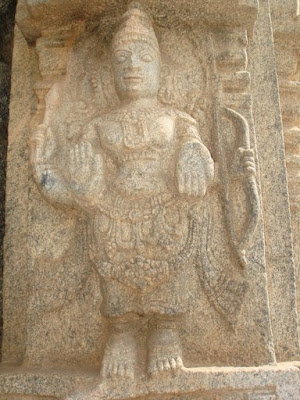 Lord Rama
Gangala murthy( one of the 64 forms of Lord Shiva)
Lord shiva is said to be associated with destruction, dancing in cemeteries, wearing the skulls and bones etc. Why ? While everybody irrespective of human, animal, plant, devas, asuras and all creatures at the time of
praLaya get reduced (die) to be created again in the next prapanchOtpatti, God is the only one, Who is ever present. Indicating this Eternal being of God is the skulls, skeleton ornaments and the concept that he dances in the cemeteries.
GangALar is the mUrti after reducing all the creations into Him. He will be having a staff with bones collected in it, which is an indication of destruction. He alone will exist and will be enjoying the Self.
 Godess Shakti or Parvati devi
 Lord Muruga
/ Karthikeya (also called as the one with six-faces) on his vaahanam peacock.

The stone chain found in the above temple.
Shown for a comparison is also a stone chain but from Kancheepuram Varadarajar temple.

 The ever guarding Nandi.
 Dvajasthambam
(the 3 cross bars at the top indicate ichcha shakthi, kriya shakthi and jnana shakthi of the lord). The temple itself signifies our body where the gopuram is our paadham, the garbha griham is our head, ardha mandapam is the neck, maha mandapam is chest and dvajasthambam the naabhi.

....my earlier visit to Talakadu (in 1997, ie. 11 years before)

Paathaleeshwarar temple (one of the 5 shiva temples that went under sand)

the same temple 11 years ago(sand covering the entrance that is seen here has been removed completely now and a new overhead cover has been added in front of the temple as seen in the previous photograph)

Another temple which has been excavated.(not sure whether it is Shiva temple or a Vishnu temple as the temple was closed during our time of the visit).
remains of the above temple's wall scattered on the ground(we spotted some new stones there too)
 This is the Hoysala temple for lord Keerthi Narayana in Talakadu which
 we saw in 1997 (don't remember seeing it in the recent trip)


A dingy ride(பரிசல் in tamil) in the river cauvery near the temples in Talakadu is refreshing.
Somnathpura (should not be confused with the one in Gujarat)
This place is also a very historical one dating back to 1268 A.D , when the Hoysala emperor Narasimha III's general Somanatha Dandanayaka built a temple for Lord Vishnu to commemorate a victory of the Hoysalas over the cholas. The architecture here is typical to Hoysalas, other examples being at Beluru and Halebeedu though among the three sites this one is known for its overall symmetry.
Very early Hoysalas were Jains. Ramanujacharya , who had to be in disguise due to persecution of Vaishnavaites by Krimikanta chozha was forced to leave chozha country for 12 years until the next king ascended the throne. For these 12 years, starting from 1096AD, he took refuge in Karnataka(Melkote) and during this time he cured a peculiar disease of Queen Shantala devi, wife of Vitthala Deva(popularly known as Bitti Deva) . Therefore, the prince converted to vaishnavism and was called as Vishnuvardhana thereafter.(He was not the reigning prince at that time but ruled over a few provinces under his brother Bellala). From then on there were pious vaishnava kings in the dynasty. There were some Shaivite kings also among the Hoysalas for we find grand temples to Lord Shiva as well, as seen in Halebeedu.

The lamp post at the entrance to the temple

The huge polished granite slab at the mahadwara, is a treasure for, in beautifully engraved old kannada, it gives details about the construction of the temple and the rulers who contributed to its completion and upkeep from the 13th to 16th century A.D.

The lathe carved pillars (typical of the Hoysala style of architecture)
The method employed was a primitive form of lathe. The pillar was mounted on a potters' wheel and animals were made to go around the wheel(probably with sharp tools tied to them at required levels) and the shapes were carved. The symmetry achieved is amazing!

Grand view of the trikuta(3- topped) vimana temple of Somnathpura
All the sculptures in the temple have been carved on a special type of stone called soapstone(largely composed of the mineral talc and rich in magnesium). A unique property of soapstone very useful in making sculptures is that it is initially soft when under the ground and hardens gradually over the years when exposed to the atmosphere. Therefore, during the time of building the temple, fresh soapstones were used to ease the carving process. They hardened in course of time.
Outer Prakaram

The temple is adorned with sculptures, rightly described in English as
poetry in stone. The outer wall of the temple throughout has 6 bands of aculptures, above which the main sculptures of the deities are found. While the lowermost band has elephants(totalling to 540, no two being the same), the next band has horse riders. The third band has running floral designs throughout. The fourth and the most painstaking one portrays scenes from epics, Ramayanam and Mahabharatham. The fifth band has the figure of a chimera(made of 7 different animal parts). The sixth band has swan as its main theme, though variations are found in this panel. Erotic scenes from Kamasutra are also found in few portions.
 A close-up view of the lower three bands(the imagination of the sculptors is best seen rather than described)

Another view of the 6-band art

A war scene from the epics neatly executed on stone.(Observe the dynamism in representation. Even the horses seem to have entered a fighting mood)

The epic panel runs in time from the right to the left of the temple. In this picture, if observed closely, one can see the cradles of all the babies(Rama, Lakshmana, bharata and Shatrugna) rocked by the elders. In the next stage in the left panel, we see that the babies begin to crawl.

Outlet for abhishekam water from inside the temple. This is a made out of a single long stone.

One of the elephants adorning each corner of the 36-pointed star base of the temple


The dvarapalakas to Somnathpur temple

Vishnu sitting on the 7-hooded Adisesha(comparitively rare posture against his most popular reclining pose)


Saraswati Devi

lord Vishnu, Lakshmi devi and Lord Krishna

Lord Vishnu in many variations of postures and mood

Lord Vishnu (with Shanku , Chakra , gadhaa, padmam)

Lord Rama ( with his kodhandam) shown in his original form as Vishnu

Shadbhuja vishnu (as against his usual chaturbhujam posture)

Indra, chief of the devas, with his vajrayutam in one hand

Vishnu in ardhapadmasana(a yogic posture considered rare for representation of Vishnu).Usually Lord Shiva is portrayed in this way.

Nardhana lakshmi(dancing pose). Note the maize on her right hand.

Shadbhuja vishnu with different weapons in his hand

Brahma with his weapons. While one or two garbhagrihams alone separately exist for brahma in the whole world, images of him in the walls around a temple are not uncommon. Brahma is not separately worshipped because he also a jivathma who has a fixed lifespan(though that span is very great compared to life in bhoolokam, approximately 311.04 trillion human years)

Dhanvantri, the divine healer. He is considered an avatar of Lord Vishnu and rose from the ksheerabdhi when it was churned with the mandhara mountain. He has a amrita kalasam in one hand and a leech on the other representing the dual role of giving positive energy as well as removal of all diseases including the disease called as our samsara.

Dhanvantri in Tanjore style.(Note the leech on the right hand and kalasam on the left)

Lakshmi devi in a graceful posture
An extremely rare depiction of the matsya avatar of lord vishnu. Notice the fish's face brought out elegantly on stone.
Let us be protected by the fish form of our God, which appeared for, Searching for the Vedas, with tense examining looks And Created a mirage of the lotus forest in the great waters of the sea, And appeared to climb on the swing created by the dashing of waves with waves.
- Dasavathara Stotram by Vedanta desika(1269-1370 A.D)
(shown on the left is Raja Ravi varma's depiction of matsya moorthy)

Varaha avataram of Lord Vishnu, to save bhoomidevi

Lakshmi Narasimha, avataram of Lord Vishnu to save prahalada from Hiranyakasipu.
A creative sculpture showing Hanuman with the baana lingam in his hand.[
He was asked to bring a shiva linga from the himalayas by Rama when they had to perform a pooja at Rameshwaram to clear the brahmahaththi dosham which had been caused due to killing of Ravana(a brahmin). Since it took a long time to get one and the auspicious time was nearing Rama and Sita devi made a lingam out of sand and started the pooja. When Anjaneya arrived he was sad to see that his efforts were fruitless. So lord Rama granted him a boon that thereafter, the lingam brought by Hanuman would be worshipped first and then only the bhaktas should worship his shivalingam. Thus there are 2 lingams in Rameshwaram till today and pooja is performed as directed by Lord Rama].
The story inside the braces is a cooked up story . See comments section for additional information.

Indra and sachidevi(indraani) on airavatha

Lord Vishnu and Lakshmi devi on their vahanam Garuda(one of the nityasoori-s)

Mahishasuramardhini in a dynamic fighting posture

Lakshmi devi with Lord Vishnu. Here godess Lakshmi rests her feet on a tender lotus because of which the lotus bends slightly. The elephant gives support to the lotus with its trunk.

The chimera made up of seven animal parts(of which i remember 6, namely crocodile mouth, pig's body, lion's foot, peacock's tail,some part of elephant and cow too). Each one stands for a specific character which the hoysalas wanted to portray in their important symbol.

A beautiful Annapakshi is shown feeding its chicks. We see that the artists took so much inspiration from nature and saw divinity in the whole thread of creation.

This is a wonderful forest scene,with its trees, cows, mountain etc. as a part of the epic band of the temple. This can be used to explain stylization in art, which from times immemorial is a characterising feature in Indian art tradition. The artist finds himself in ease with space and movement in stylization unlike static realism.


Krishna with govardhanagiri

This is the scene from Mahabharata where Bhima gets food to Bakasura. Later he fights and kills him thus saving the villagers from the wicked asura.
Other assorted sculptures:


Inside the temple
We are baffled by the intricacy in architecture once we move inside the temple. Our guide told us that there are 16 different types of ceilings in the temple. Here we find a imaginative and a rare portrayal of 4 stages of development of a banana flower.Some of these ceilings :


Note the colour that has been aptly used for the banana flower as well as in the designs surrounding it. This gives a natural flavour to the already well-carved banana flower by simple usage of vegetable dyes.


The last 2 of the above snaps show the ceilings where the banana flower is fully developed.
One more ceiling(which is in the room adjacent to the garbhagriham)

Here also we find lathe-turned pillars. There are also other kinds of pillars where the symmetry is laudable. It is said that the temple construction took a total of 65 years!(quickly finished when compared to Beluru and Halebeedu which took hundreds of years)


Lathe turned pillars just outside the garbhagriham

This is a trikuta vimana temple (one with 3 tops or 3 vimanas) and hence has 3 residing gods .
Keshava, Janardhana and Venugopala are the 3 gods of the temple. (These are one of the very few sculptures in the whole temple that have their noses intact. A sad but common feature seen in the temple is that the noses of most of the forms have been chipped out by the invaders. It is said that their plan was to render the temple an inactive one because generally Hindu deities which have been damaged are not worshipped. Even the animal forms have not been spared by the invaders. Trunks of elephant etc. which show power have also been truncated.)
There are miniatures of the respective idols at the entrance of the garbhagriham.
 Venugopala
The details and intricacy of the sculpture is beyond words. Cows and calf were very dear to Krishna and here they stand captured by the divine music of the lord. Even the ten avatarams are carved in the pointed arch that envelops the tree under which Krishna is standing. The tree is no lesser than reality for the eyes.
 Miniature of venugopala at the gateway

Keshava
This was the idol that went missing in the intermitant period(mostly due to muslim invasions) and has been reconstructed from an idol on the outer wall as well as by adding new parts to it.
 Miniature of Keshava at the gateway
 Janardhana
meaning, one who is birthless (Na Jayathe) and who redeems the suffering of his Bhakthas (Ardhayathi Cha Samsaram). Here the sufferings refer to “Samsara.” Since he does both he is called “Janardhana.”
Here our guide stepped in to point out that with a little bit of imagination we can see a cow's face if we carefully observe the chest and stomach portion of idol of Lord Janardhana. (We were excited to see the excellent proportions that went into making of the idol that gave these two perspectives.)

New designs combined with old ones serving the purpose of window. This is one of the places where renovation work has been done to a great extent.

A neatly maintained temple garden by ASI(though some tourists feel that it mars the ancient feel of the monument)
A grand view of the temple

This is a snap from the corridors on the inner periphery of the temple. There are 64 small mandapams which originally housed different deities but were totally uprooted or damaged during the 1311 and 1326 muslim invasions.
We can see the names of some of the sculptors on their works as they seemed to have signed their works.
From the names it is evident that the artists were both local and from outside the region. The famous Ruvari Mallithamma, Masanithamma, Chameya, Rameya, Chaudeya and Nanjeya are considered locals while Pallavachari and Cholavachari are thought of as artists from Tamil country.(Courtesy: Wikipedia)

Our group
We left the temple with a feeling of shortage of time to see the entire temple. Infact rain took away its own share of our time during our visit to the temple. There are also so many sculptures near the ceiling inside and on the vimana outside which almost none of the visitors can see properly.
Shivanasamudra (known to most people as Shivasamudra)
This place famous for its 2 waterfalls, Gaganachukki and Bharachukki completed our one day trip. Here we have the second highest waterfall in India. We encounter this place in our geography textbooks in the context of first hydro-electric project established in India in 1902, because of which Bangalore was the first city to receive power in India in 1906.
Bharachukki had more water during our visit in June. We also enjoyed a dingy ride here. We have to climb quite a few steps from the point where the vehicles halt to the place from where dingies are available.

Gaganachukki had less water(below)

Gaganachukki during our visit in 1997(below)

This view is from diametrically opposite place than the one taken above
For more information on the falls read:
The trip was a nice refreshing one, away from the monotonous life that most of us have these days. Religion, history,myths, architecture, nature, travel and some local food spiced up our little trip.


